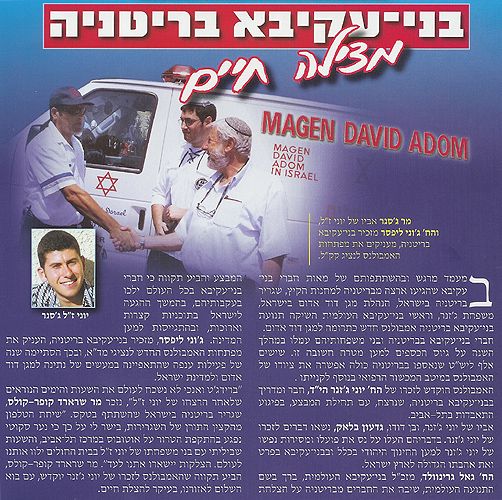
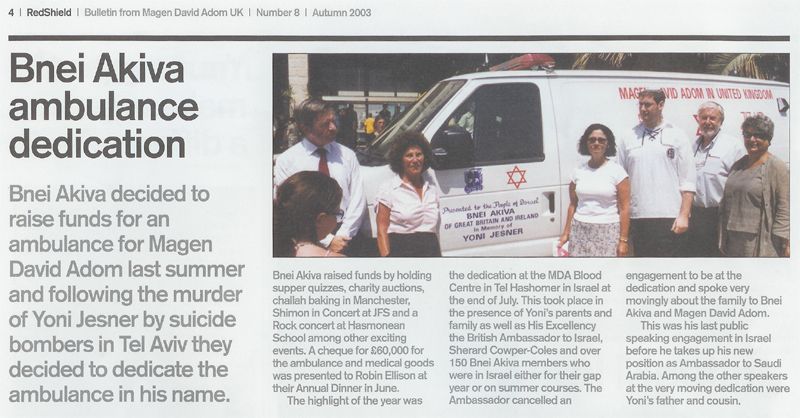
 Bnei Akiva Ambulance Dedication
20 July 2003 at MDA Blood Centre, Tel Hashomer
Time, they say, heals all wounds, dulls pain, makes everything better. Perhaps it does, sometimes. But often I am not so sure. The instant shock, the sudden pain, ease, of course. That I admit. But later, all of a sudden, the sense of profound loss, the awful sadness, the anger, the acceptance that a young life is no more, come pouring back again.
And always the scars remain. And so it is with Yoni Jesner, of blessed memory. His arbitrary, awful, death scarred us all. His family, first, foremost and forever. I am so pleased to see them all here today at this ceremony: his grandmother, Vivian, his parents, his brothers and sisters and cousins.
Yoni's pointless death scarred us all. All his friends in Bnei Akiva, of course, so many of whom are here today. But also the closely-knit worlds of Anglo-Scottish Jewry, both here, and in Israel.
Nor will Bridget and I ever forget the awful hours and days following his death. The phone call from the Embassy Duty Officer, saying that a boy from Scotland had been hurt in the terrorist attack on the Tel Aviv bus. Those hours in the hospital, with the family facing up to fateful decisions on Yoni's life. None of us will ever forget those moments. Their scars are with us forever.
What we say here, what we do here, today, will soon be forgotten. But Yoni will not. His unsought, unplanned, legacy will live for generations to come. Especially, but not only, through this ambulance. This symbol of salvation and rescue and rehabilitation. In this ambulance, through this ambulance, we salute Yoni's memory. And we turn the uncompromising evil, the utter pointlessness, of his murder to a wider and higher purpose. I salute you all for what you have done to bring this about.
Perhaps I could end on a more personal note. This will be my last formal public speech in Israel. And the emotion I feel, perhaps unusually for an occasion like this, is pride. Pride in having represented my country in Israel over these past two, most difficult of, years. Pride in having represented Anglo-Jewry here. Proud of what you do for Israel and for peace. Proud of the fact that 140 young people from Bnei Akiva are here supporting Israel at this time. And proud too of Mada, for everything you do to save life, working in the United Kingdom and here in Israel.
And, finally, I am glad that there are at last some shafts of light through the dark clouds of terror.
For, in the end, that is what this ceremony is about: ensuring that good triumphs over evil, hope over fear, and a better future over a sad past.
 Bnei Akiva Ambulance Dedication
20 July 2003 at MDA Blood Centre, Tel Hashomer
For six and a half decades, Bnei Akiva of Great Britain and Ireland has played an outstanding role in educating young people, and communicating to them our ideals and belief of Torah va’Avodah in the Land of Israel.
People don’t often realise what youth movements can achieve, but this morning, I stand here proud in front of the evidence of our unwavering commitment to the Land and the People of Israel.
Last August, participants of Bnei Akiva’s summer machane launched an ambitious campaign to raise money for an ambulance for Israel’s emergency medical service, Magen David Adom.
It is with an immense amount of pride that I stand here eleven months later with the news that we have exceeded our target beyond all expectations, and have raised over £60,000, which has been enough to not only buy this ambulance, but has equipped it with vital medical supplies too.
Soon after our campaign was launched, we heard the tragic news of the loss of our chaver, Yoni Jesner. It was decided that as a tribute to Yoni by his many friends in Bnei Akiva, we would dedicate the ambulance in his memory.
It has been a challenging year for our chaverim to deal with the loss of Yoni, and through a variety of projects and events, they have focused their efforts to honour Yoni’s name.
To some people here, Yoni was your chanich. To others, he was your madrich. To all of us, he was a member of Am Yisrael. A nation is only as significant as its ideals, and Yoni lived those ideals to the maximum.
May today serve as a turning point for Israel, and lead to lasting peace and an end to terror.
 Bnei Akiva Ambulance Dedication
20 July 2003 at MDA Blood Centre, Tel Hashomer
I have many things that I am eternally grateful to Yoni for, one being that he introduced me to Bnei Akiva. It was ten years ago that my dad told me that he had received a message from Yoni saying that he had applied to Aleph Machane and that I should too. So I did. I was hooked immediately, and having been to fifteen camps since, one could say that I haven't really looked back. So as a proud member, and on behalf of Yoni, I would like to thank Bnei Akiva for all it gave him, and for all it continues to give me. I would also like to thank all those who made donations in order to fund this ambulance. The inspiring way in which Bnei Akiva has reacted to Yoni's death pays fitting testimony to the movement it is.
Seeing so many people here on Israel Machane makes me think back to exactly four years ago when Yoni and I were on tour (Group 3!) together. I remember how whenever we would pack our suitcases on to our bus, only about half of them would fit on, and during the ensuing argument between the driver and our group, without being asked, Yoni would single handedly take all the luggage of the bus and repack it - always managing to fit everyone's bag in. I also remember how Yoni lained Eicha so beautifully on Tisha B'Av as we sat overlooking Jerusalem.
We now have two physical objects that represent Yoni. The first is his tombstone on Har Hamenuchot in Jerusalem. The second is this ambulance that stands before us today. They seem to stand for opposing themes and have very different attributes. The stone stands still and strong, and will remain in it's current place for many, many years. The stone symbolises ending and finality. To friends and family this is our physical point of contact with Yoni in this world. The ambulance on the other hand is new and mobile. It will be active and it gives life. To those who probably never knew Yoni but are in need of assistance of some sort, this will be their physical point of contact with Yoni in this world.
Nevertheless, in spite of their clear differences, that which they symbolise is closely related. Yoni has run his leg of the relay race. He can no longer be active in this world. He has put down his stone at the point which he reached in his life. It is now up to us to carry on running, and to take the baton from his open hand. Here the ambulance awaits ready to continue his good work just where he left off. It is amazing that the day we dedicate this ambulance in Yoni's memory is probably the same day, that had Yoni still been alive, he would have been going back to London to start a degree in medicine.
I cannot think of a more fitting dedication to Yoni than an ambulance. Yoni told us many times how he wanted to follow in our Grandfather's footsteps and be a doctor. He actualised his keen interest when he came to Israel to work in Hadassah Ein Kerem during his summers for work experience. Whilst Yoni can no longer be a doctor, the ambulance will do the same things he would have done - save people's lives.
In fact Yoni's own birth saved life. When my Auntie Marsha, Yoni's mother, went into labour her doctor was called into hospital to assist with the birth. The lady in the ward next door found herself in a sudden life threatening situation, and only because this specific doctor was in the hospital for Yoni's birth, when usually he would not have been on duty, was he able to save the life of this suffering lady. As we are well aware, Yoni's death gave life to three different people with the donation of some of his organs. It seems that Yoni was all about saving people's lives, and now everyone who is rushed to hospital or given treatment in this ambulance can thank Yoni for their new lease of life.
With the Gemara in Sanhedrin in mind (that states whoever saves a life it is as if he has saved an entire universe) we can be rest assured that Yoni is resting in peace in heaven. In fact I can't imagine Yoni resting, so it is probably more accurate to say that Yoni is running around in peace in heaven. I think another Gemara is relevant here as well. In Kiddushin it states "macshava tova metzarpha lema'aseh" - "a good thought is considered as a good deed" - and the Gemara qoutes the following Pasuk from Malachi as a proof: "Az niberu yirei Hashem ish el re'eyhu, vayakshev Hashem vayishma, vayichtav sefer zichron lfanav lyirei Hashem ulchoshvei shmo." - "Then those who fear Hashem spoke to one another, and Hashem listened and heard, and a book of rememberance was written before Him for those who fear Hashem and for those who give thought to His name". The Gemara asks: "Mai Ulchoshvei shmo?" - "what does the phrase 'and those who give thought to his name' refer to?" "Amar Rav Assi: aphilu chashav adam la'asot mitzva vne'enass velo asa'a ma'aleh alav hakatuv k'ilu asa'a" - "Answers Rav Assi: it means that even if one plans to do a mitzvah and something beyond ones control prevents you from performing the mitzvah, the Torah credits you as if you fulfilled it." Clearly Yoni falls into this category. There were numerous Mitzvot that he planned to do, but was prevented from fulfilling them due to his sudden death.
America is famed for its Satue of Liberty, well I feel that Yoni was a statue of responsibility. Today society is so keen to ensure that everyone can fully exercise their rights, that we forget hat we also have duties and responsibilities to fulfil. Yoni did not forget this. He bore his responsibilities with broad shoulders, and did mitzvot even when they may not have been his duty. You never heard Yoni with folded arms saying, "someone else can do it - it's not my job." I think this is the message that Yoni would want us to take with us today; to accept responsibility upon ourselves even when we may not be expected to, and to fulfil our duties willingly, without being overly concerned for what we feel society owes us.
To conclude I would like to sincerely thank His Excellency, Ambassador Sherard Cowper-Coles, not only for making the great effort to be with us here today, but also for being a true, caring friend of the Jewish people in both Britain and Israel. We are very sad to see you leave Israel, yet we are encouraged with the knowledge that you will continue to represent our cause in your new post in Saudi Arabia.